
Last updated November 18, 2026
 Wrought iron
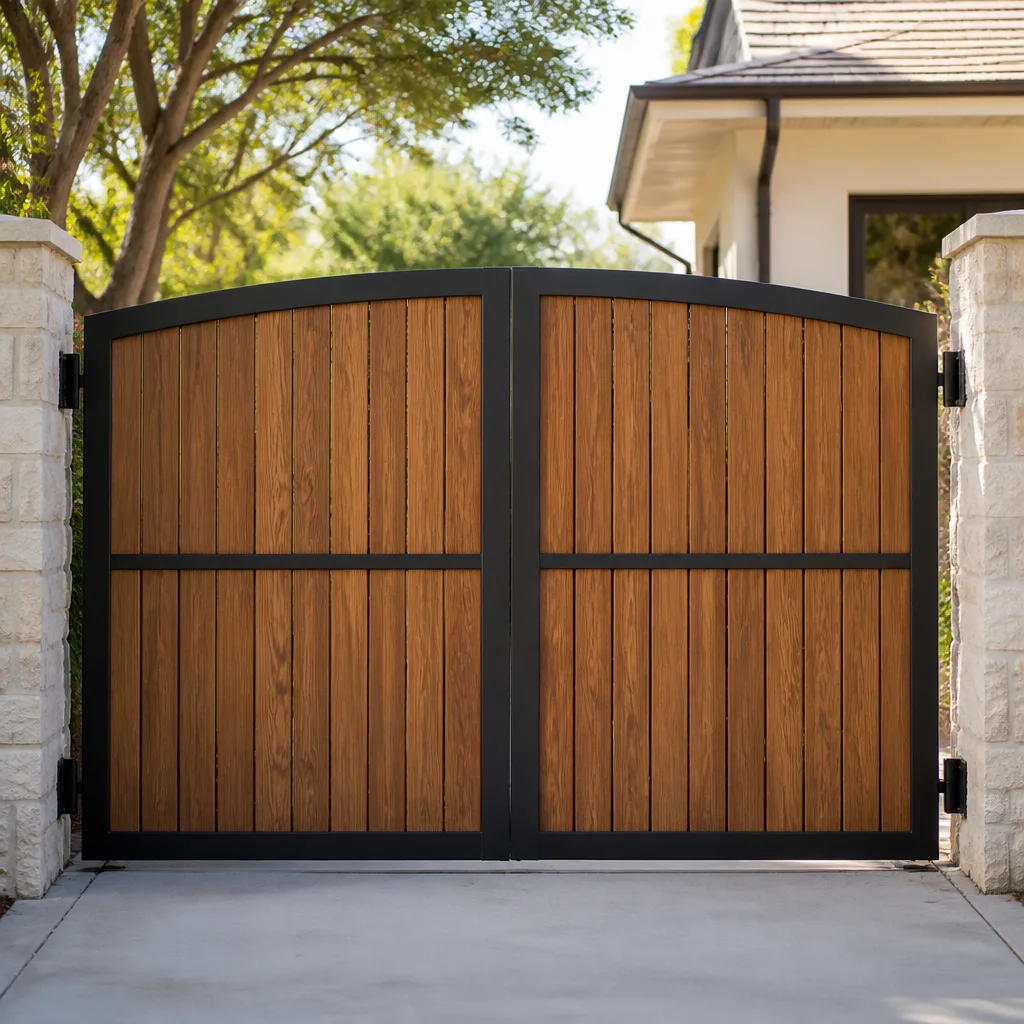 Wood & steel frame
 Farm & ranch
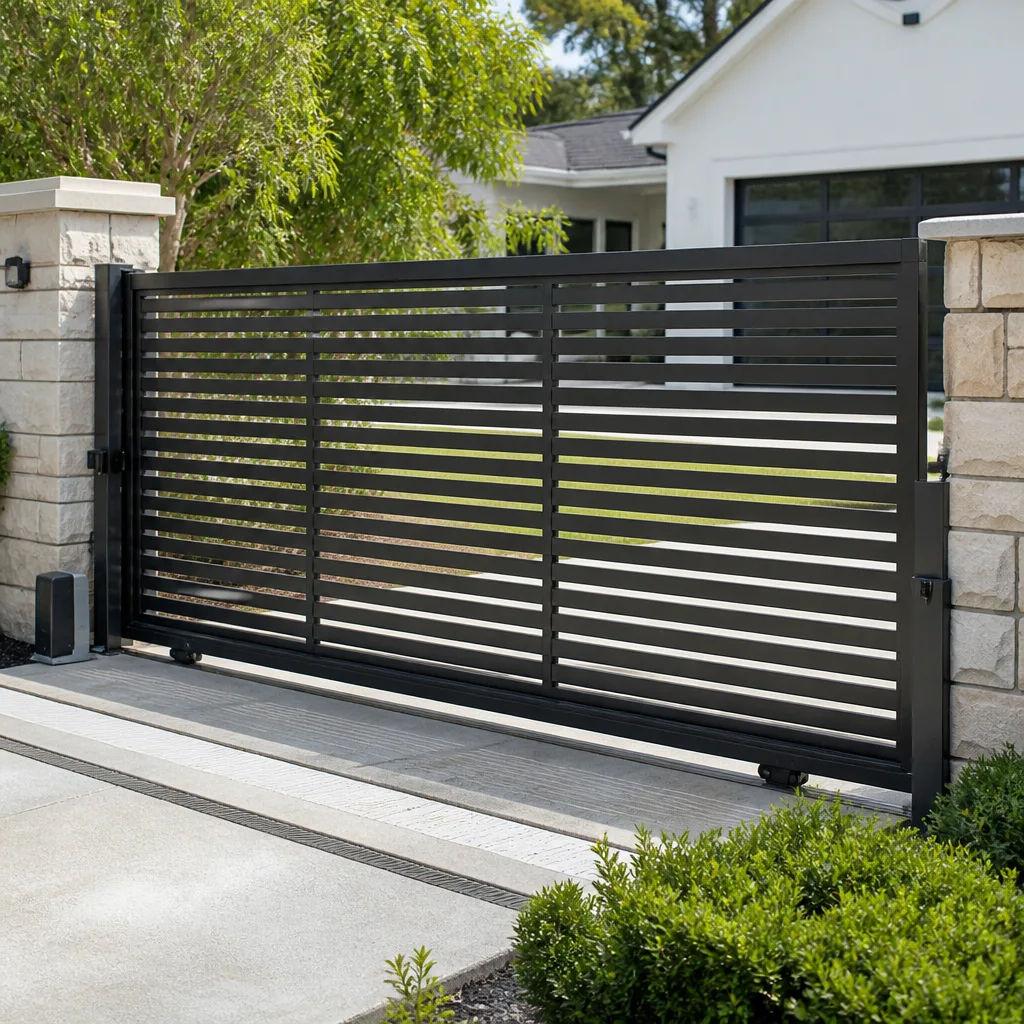 Sliding driveway gates
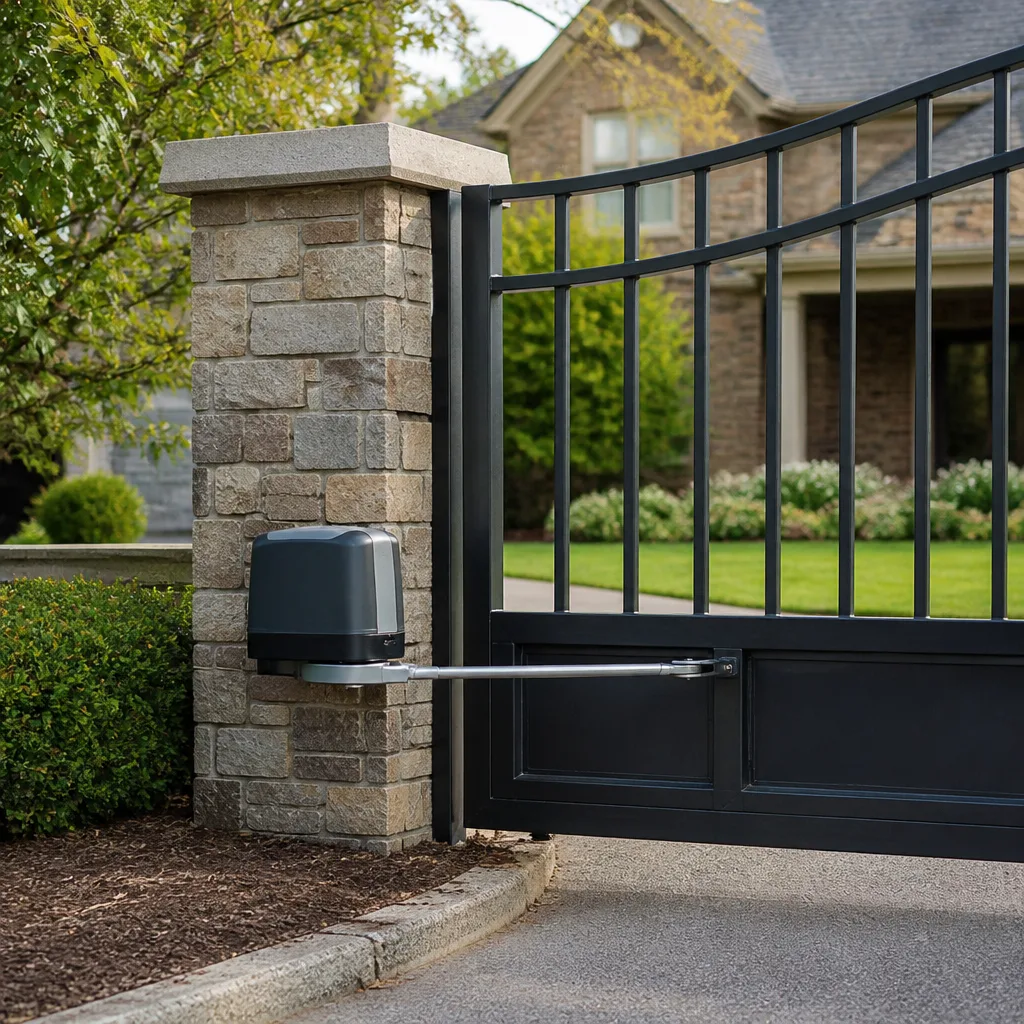 LiftMaster operators
Free on-site gate assessment - hinges, posts, and your LiftMaster or Nice gate operator checked before anything is quoted
The assessment is free and the quote is the invoice.
Get your free estimateDIY vs Professional Gate Repair: What’s Safe to Do Yourself
Two homeowners spend a Saturday working on their gates. One replaces a worn hinge, saves a service call, and the gate swings cleanly through Sunday. The other turns one adjusting screw on an automatic opener and ends up with 120 volts through a wet hand, or a 400-pound gate that drops without warning on a child walking through. Both of those jobs get filed under “DIY gate repair,” but only one of them was ever a reasonable thing to do yourself. The difference isn’t how handy you are. It’s whether the repair touches live voltage, structural load, or warranty-bearing parts. This guide breaks gate work into three honest categories, so you can see exactly where your own skills end and a licensed technician’s begin. We’ve watched these jobs go well and go badly in Winchester, and the line is clearer than most people think.
Quick Answer
Safe DIY gate repair covers cosmetic and light mechanical work: cleaning tracks and hinges, tightening bolts, touching up rust, replacing a latch or a handle. Anything involving live electrical voltage, the weight and swing of the gate leaf, spring tension, or a motor and control board belongs to a licensed technician. If a repair falls in the middle, and you’re unsure, that uncertainty is itself the answer: get a professional opinion before you touch it.
Styles & brands we work with
- Wrought iron
- Wood & steel frame
- Farm & ranch
- Sliding driveway gates
- LiftMaster operators
Table of Contents
- The Three-Category Framework for Gate Repairs
- Category 1: What’s Genuinely Safe to Do Yourself
- Category 2: DIY-Able With Proper Research
- Category 3: Repairs That Must Go to a Licensed Technician
- Why “I Turned the Breaker Off” Isn’t Always Enough
- Leased and HOA-Governed Properties: The Hidden Exposure
- The Real Cost of DIY Tools vs a Service Call
- How to Check Whether You’ve Voided a Warranty
- Common Mistakes to Avoid
- When to Call a Professional
- Frequently Asked Questions
The Three-Category Framework for Gate Repairs
The useful question is not “am I handy enough to fix this gate?” It’s “what does this specific repair actually involve?” Sort every job into one of three buckets before you pick up a wrench.
Category 1: Safe DIY. No live voltage, no control over the gate’s weight or swing, no warranty-bearing component. Cleaning, lubricating, tightening visible bolts, replacing a handle or a knob.
Category 2: DIY-able with research. The repair is mechanical and low-risk, but it has a right and a wrong way that isn’t obvious. Replacing a latch, adjusting a roller on a sliding gate, or swapping a gate stop falls here. You can do it, but only if you’ve read the manufacturer’s instructions for that model and understand what the part does.
Category 3: Licensed technician only. Anything that touches line voltage, the drive train under load, spring or counterweight tension, or a control board the manufacturer built a warranty around. On an automatic gate, that’s most of the system.
Why sort this way? Because the risk of a DIY gate repair doesn’t scale with difficulty. It scales with what the repair can release. A hard-but-safe task (replacing a handle) is still safe. An easy-but-dangerous task (turning a limit screw) can be catastrophic. In Winchester, where summer heat expands metal and winter cold contracts it, the seasonal forces on a gate make the margin for error on load-bearing parts even narrower. We’ve seen a gate that opened smoothly in June bind and jam by August because a homeowner adjusted a stop by feel with no gauge.
Category 1: What’s Genuinely Safe to Do Yourself
This list is short, and that’s the point. If a repair is on it, you can handle it without a service call. If it’s not, be honest with yourself.
- Cleaning tracks, hinges, and rollers. Dirt and debris are the most common cause of a sticking gate. A stiff brush, a shop vac, and a rag handle most of it.
- Lubricating hinges, latches, and exposed moving parts. A silicone or lithium spray on the pivot points quiets a squeaky gate and slows wear. Follow the manufacturer’s advice; grease on a roller track can attract grit.
- Tightening visible bolts and fasteners. A gate loosens over years. Snugging a hinge bolt or a bracket bolt is fine, provided you can see both sides of the connection and the gate isn’t under load when you do it.
- Touching up rust and paint. A rust spot on a steel gate grows. Sanding and painting slows it and costs little.
- Replacing a handle, knob, or decorative cap. Cosmetic hardware that isn’t part of the gate’s structure or its latching safety.
What all of these have in common: none of them move the gate’s weight, none touch electricity, and none affect how the gate closes against a person or a vehicle. If a repair changes how the gate behaves when it’s moving, it’s no longer on this list. That’s the clean dividing line.
Category 2: DIY-Able With Proper Research
The middle category is where homeowners get into trouble, because these jobs look like Category 1 but aren’t. You can do them. You just can’t guess at them.
- Read the manual for your exact model first. A latch on a FAAC swing gate is not the same as a latch on a Viking slide gate. The clearances, torque values, and sequence of assembly differ. Find the manual before you buy the part.
- Photograph the assembly before you take it apart. Disassembly is easy; getting it back together correctly is where the time goes. Photos of every bracket, bolt, and spacer save you an afternoon.
- Confirm the part number matches what’s on the gate. Manufacturers change parts between production runs. A latch that looks identical on a website can be a quarter-inch off.
- Test the gate by hand, not by motor, after the repair. A sliding gate you can roll smoothly by hand is a good sign. If you feel binding, stop and don’t run the motor.
Examples of middle-category work: replacing a mechanical latch, swapping a worn roller on a sliding gate, replacing a gate stop, adjusting a catch plate that no longer lines up. What keeps these in the middle and not the danger zone is that none of them involve live voltage, spring tension, or the weight of the gate leaf itself. In Winchester, where a slide gate sitting in a sun-baked driveway can heat up enough to change a latch’s clearance by a sixteenth of an inch, always test fit the part when the gate is hot, not just in the cool of the morning.
One more rule for this category: if the research tells you the part comes in contact with the motor’s control circuit, it’s no longer Category 2. Put the tools down. See Gate Motor & Opener in Winchester for what that work actually involves.
Category 3: Repairs That Must Go to a Licensed Technician
Here’s the part of the guide where we’re going to be direct with you. Some of these repairs can injure you seriously, and some can kill you. The risk isn’t theoretical: we’ve seen what happens when a gate comes down on someone, and it stays with you.
- Any work on the motor, control board, or wiring. Automatic gates run on 120-volt household current, and the transformer, capacitor, and control board all live in the same housing. The capacitor in an opener can hold a charge long after the power is off. Touching it can stop your heart.
- Springs and counterweights. A torsion spring under tension stores the equivalent of hundreds of pounds of force. When one fails under load, the gate can slam shut or the spring itself can whip. This is not a repair to learn from a video.
- Hinges and bearing plates on heavy swing gates. A 400-pound gate leaf that comes off a hinge while you’re working under it can crush you. Supporting and removing that leaf safely requires proper jacks and bracing, and knowing where the center of gravity is.
- The gate’s structural welds. A broken weld on a security gate is a structural failure. Rewelding it without knowing the parent metal and the load the joint carries can turn a fix into a new failure.
- Safety edges, photo-eyes, and reversing systems. These are the mechanisms that stop the gate from closing on a child. Never adjust, bypass, or reposition them yourself. On a BFT or Linear operator in particular, the safety circuit is tied to the control board and has to be re-tested to the manufacturer’s spec after any change.
- Limit switches and torque settings. These determine where the gate stops and how hard it pushes. Wrong settings on a Linear or FAAC operator can strip the gearbox or cause the gate to close with enough force to injure someone.
Notice a pattern: live voltage, stored energy, structural load, and the safety systems that protect people. Those four are the reasons a licensed technician does this work. Not because we know more about gates than you do, but because the consequences of an error are irreversible.
Why “I Turned the Breaker Off” Isn’t Always Enough
This is the single most dangerous mistake in home gate repair, and it’s more common than you’d think. Turning off the breaker at the panel is necessary, but it is not automatically sufficient protection on an automatic gate opener. Here’s why.
Openers transform 120-volt house current down to low voltage (often 12 or 24 volts) to run the motor. The transformer and its filter capacitors sit inside the opener housing, upstream of the low-voltage side. A capacitor can hold a charge for a meaningful time after the breaker is off. It doesn’t care that the panel is off; the energy is already stored in the component. Touch the wrong terminal or bridge the wrong two points and the current goes through you, not the motor.
There’s also a warm, easy-to-miss complication in Winchester’s summer heat: gates and their opener housings bake in direct afternoon sun. A metal opener housing can reach temperatures that make a homeowner hurry, and heat also makes the insulation on old wiring more brittle. A wire that flexes fine in January can crack in July. That cracked insulation is a live conductor you can’t see. Old wiring plus heat plus a rushed repair is how the accidents we get called out to actually happen.
The right move when a repair touches the opener is not “try to be careful.” It’s to have a licensed technician do it. We carry the test equipment to verify the circuit is de-energized, and we know which components hold a charge after the breaker is off. That’s the whole difference.
Leased and HOA-Governed Properties: The Hidden Exposure
Here’s a piece of the puzzle most homeowners never consider until it’s too late: who actually owns the gate, and who is responsible for it. If you live in an HOA-governed neighborhood in Winchester or rent a property, a DIY repair on that gate can create legal and insurance exposure you won’t see coming.
- You may not have the authority to repair it. Gate automation that serves a common driveway or a shared community gate is often the HOA’s responsibility, and the association’s governing documents usually say so. Repairing it yourself, even correctly, can be a breach.
- An unpermitted modification can void a warranty the HOA holds. If the HOA’s equipment warranty covers a LiftMaster or BFT operator and you modify the control board or wiring, the HOA and its members lose the coverage. That bill can come back to you.
- Your homeowner’s insurance may not cover your work. A gate that you repaired and that later injures a visitor in your driveway can fall outside your policy, or your insurer can deny the claim on the grounds that the work was unpermitted or outside your scope.
- Licensed technicians carry insurance and the HOA has a paper trail. Every professional repair comes with a written invoice and a guarantee. That’s what protects both you and your neighbors if something goes wrong later.
If you’re not sure whether the gate belongs to you or to the HOA, check your governing documents before you touch it. The same is true if you rent. A repair you’re proud of is worth much less than the dispute it can start.
The Real Cost of DIY Tools vs a Service Call
Another part of the picture: even if you can do a repair, does it make financial sense? For small jobs, often not. Here’s the short version of the math on the smaller repairs, which is where most DIY work happens.
- A torque wrench good enough for gate hardware. A cheap one under-torques and rounds bolts; a decent one can run the price of a professional service call on its own.
- A multi-meter that reads AC and DC and can test a capacitor safely. A low-end meter may not be rated for the voltages found in an opener. A meter rated for the job costs several times the meter you’d grab off a shelf.
- A lubricant appropriate to the part. Different metals and different mechanisms call for different products. Buying the wrong one wastes money, and the wrong lubricant can attract grit or damage a seal.
- A grinding or welding setup if a weld has cracked. This is well outside the scope of a homeowner doing a weekend repair, and the tools alone can run into four figures.
For a $100 hinge replacement, spending $300 on tools and a weekend on the repair doesn’t add up. For a $20 lubrication job, it clearly does. The honest rule: if the repair is genuinely on our Category 1 list, do it yourself. If you have to buy a specialty tool to do a repair that isn’t a recurring need, price the professional option before you buy the tool. You’ll often find the numbers are close, and the professional comes with a guaranteed repair. For a broader look at how we price and structure the work, see Gate Repair in Winchester.
How to Check Whether You’ve Voided a Warranty
One more risk that gets underestimated: a DIY repair can void the parts or labor warranty on the gate and the opener, and you may not find out until the next failure. Here’s how to check before you pick up the tool, and how to know if a warranty is already affected.
- Find the paperwork. Whether it’s a manufacturer warranty on a LiftMaster, FAAC, or Linear operator, or a warranty from the installer, the terms are in writing. Look for the sections on exclusions, unauthorized modifications, and required maintenance.
- Read the excluded-conditions section carefully. Almost every opener warranty excludes damage from water intrusion, power surges, and unauthorized modification. A repair done by an uncertified technician often counts as an unauthorized modification.
- Document what you did. If you’ve already done a repair, write down exactly what you changed, on what date, and with what part. That record matters if a warranty claim comes up later.
- Ask a certified technician before the warranty expires. A technician trained on your specific brand can tell you whether a repair attempt has voided the coverage, and often can restore it before the window closes.
In our experience, most homeowners find out about a voided warranty at the worst possible time: after the motor has already failed and they’re standing in the driveway facing a full replacement. A ten-minute conversation beforehand would have saved them the cost. When you do call a professional in, ask them to review the warranty status, not just fix the immediate problem. A second opinion costs you nothing here, and it’s the fastest way to know where you stand. For installation work where the warranty matters most, see Gate Installation in Winchester.
Common Mistakes to Avoid
- Turning the breaker off and assuming the opener is dead. The capacitor in an opener holds a charge after the power is off. Verify with a meter before touching anything inside the housing.
- Adjusting a limit switch by feel because the gate “looks right.” Limit settings need to be confirmed with the manufacturer’s procedure, not by eye. A gate that closes in the right place at noon can be short by an inch in the afternoon heat in Winchester.
- Disabling a safety edge or photo-eye to stop a gate from reversing on its own. A gate that reverses unexpectedly is usually a sign the safety system is working. Bypassing it removes the protection that stops the gate from closing on a person.
- Working under a gate that isn’t braced. A heavy swing gate on old hinges is not stable just because it’s sitting still. Before you work under it, support it properly, or don’t work under it.
- Tightening a hinge bolt on a loaded hinge. If the hinge is holding the gate’s weight, tightening the bolt while it’s loaded can strip the threads or shear the bolt as soon as the gate swings.
- Doing a repair on an HOA gate without checking who’s responsible. Repairing a gate that isn’t yours is where the warranty and insurance problems start.
- Buying parts online without matching the part number to the exact model. Manufacturers change parts between production runs, and a “close enough” part is where a weekend repair turns into two.
When to Call a Professional
The safe rule of thumb: if a repair involves live voltage, spring tension, the weight of the gate, a weld, the motor, the control board, or a safety device, call a licensed technician. The same is true if a repair touches a component covered by a manufacturer warranty, or if the gate serves a leased or HOA property. Beyond that, call if you’ve tried a Category 2 repair and the gate still isn’t behaving, or if you don’t know where the problem is. Guessing gets expensive.
The task we spend the most time on in Winchester is undoing a repair that a homeowner started and couldn’t finish. Where we can, we finish it correctly and back it in writing. Where we can’t (because a motor or control board is damaged), we say so upfront. Our technicians are trained on FAAC, BFT, Linear, and Viking operators, and we quote the price before a single bolt is turned, so you never get a surprise on the bill. Free estimates are available across Winchester. Call (866) 984-8340 to talk through your gate.
Frequently Asked Questions
No. Limit switches set where the gate stops, and getting them wrong can strip the gearbox or cause the gate to close with enough force to injure someone. A licensed technician on the correct brand of opener has the tools and the procedure to set them to the manufacturer’s spec. Call (866) 984-8340 for an exact quote; estimates are free.
Only if the hinge isn’t carrying the weight of the gate and you can see both sides of the connection. A hinge on a heavy swing gate is a structural component, and if you’re not sure whether it’s load-bearing, don’t do it. Our technicians are trained on gate hardware and safety hardware together for a reason.
We take calls 24 hours a day and can usually get to a Winchester gate motor failure quickly. Whether the same day works depends on the brand of the operator and the part needed, and we’ll tell you plainly when you call. Call (866) 984-8340 now and we’ll talk through what’s happening with your gate.
A typical professional gate repair in Winchester depends on the component, but the price is quoted and agreed before any work starts. That said, we don’t want the quote itself to be a surprise. Call (866) 984-8340 for a free estimate on your specific gate, and we’ll give you a number before anyone touches a bolt.
It can. Most opener warranties exclude unauthorized modifications and repairs done by uncertified technicians. If you’ve already done a repair, tell the technician when you call so they can check the warranty status before more damage is done. Call (866) 984-8340 for a free second opinion on any written estimate.
Probably not. Shared community gates and common-driveway automation are usually the HOA’s responsibility, per the governing documents. A repair you do yourself can void a warranty the HOA holds and may fall outside your homeowner’s insurance. Check the documents first, then call a licensed technician who can document the work.
The Bottom Line
Sort every gate repair into one of three categories before you touch it: safe DIY (cleaning, lubricating, tightening, cosmetic hardware), DIY-able with research (latch and roller swaps with a manual in hand), and licensed-technician-only (live voltage, springs, heavy gates, welds, motors, control boards, and safety devices). The line is drawn by what the repair can release, not by how hard it looks. If you’re unsure which side of the line you’re on, that uncertainty is your answer. For everything on the licensed side, do the math and make the call: a professional repair quoted upfront and backed in writing protects your gate, your warranty, your insurance, and the people who walk through your driveway every day.
If you’re on the fence about a repair, call Ironworks Gate Co. Winchester home and let us take a free look. We’ll tell you honestly whether the job belongs in your hands or in ours. Our technicians have up to 13 years of experience, and every repair is backed by our 90-Day Done Right Promise: if it’s not right, we come back and make it right, in writing, no arguing. Call (866) 984-8340 for a free estimate in Winchester.
Written by the team at Ironworks Gate Co. Winchester.
See the difference
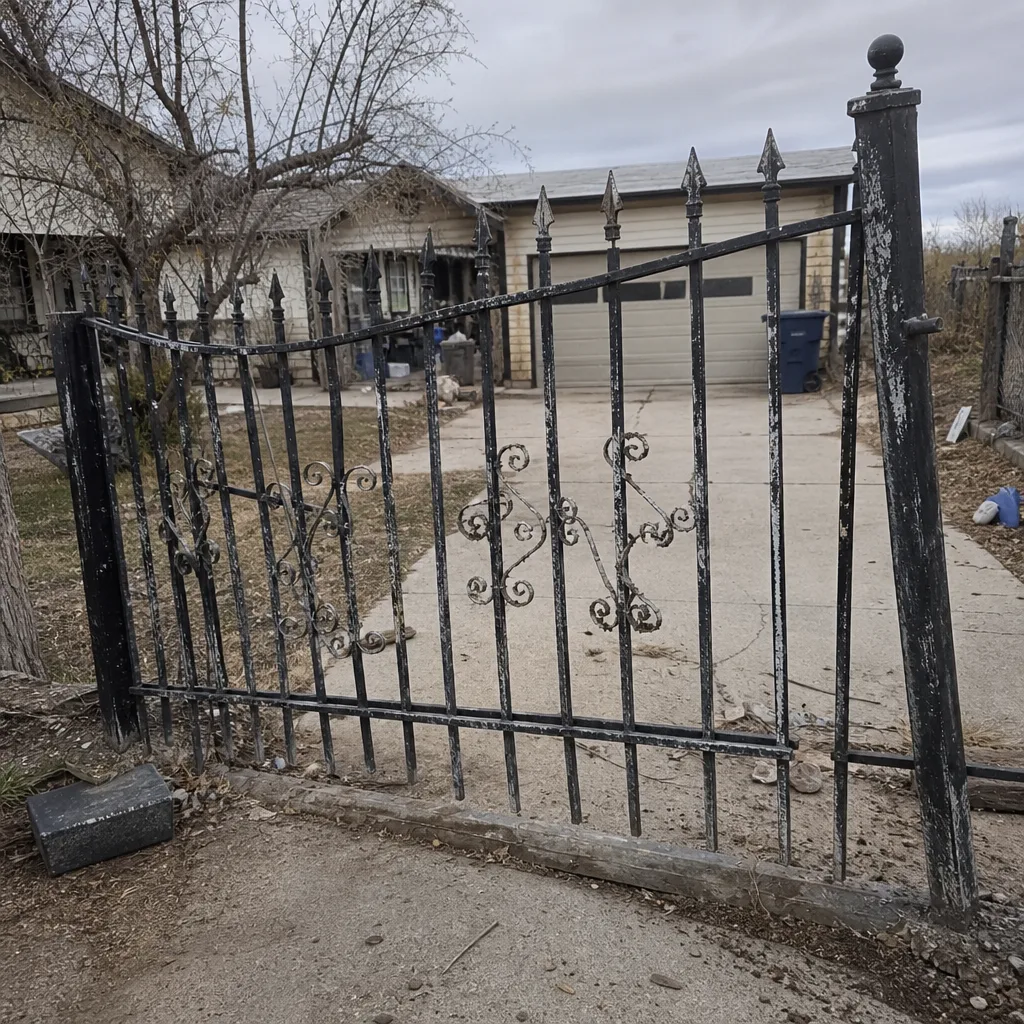 Before
 After
 Before
 After
 Before
 After